> ## Documentation Index
> Fetch the complete documentation index at: https://docs.contributor.info/llms.txt
> Use this file to discover all available pages before exploring further.
# Lottery Factor
> Find out if your project has a single point of failure — see how many contributors you can afford to lose before critical work stalls.
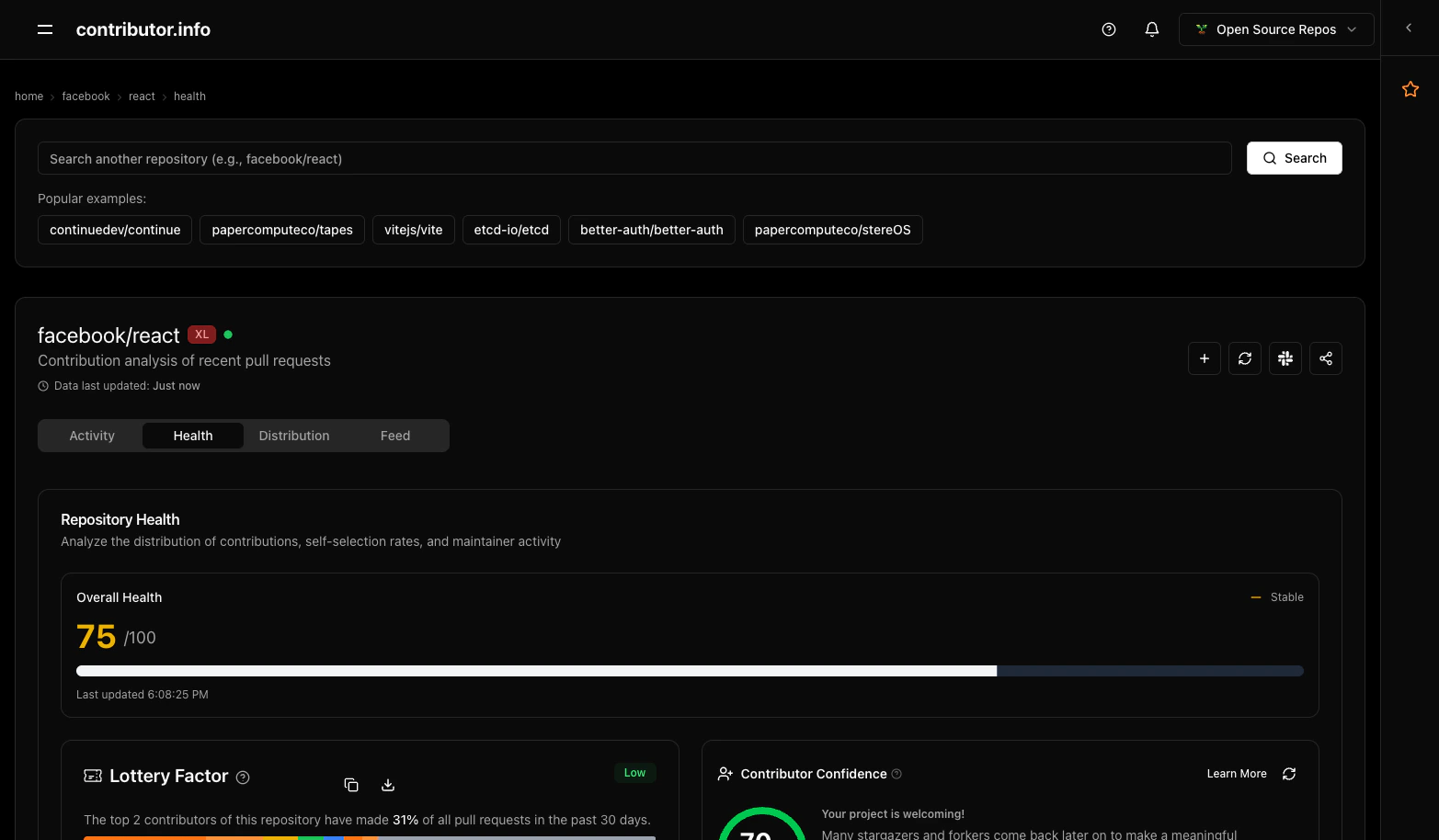
The Lottery Factor measures knowledge concentration risk — how many contributors could you lose before the project fails? It answers: *if key contributors won the lottery and left tomorrow, how resilient is the project?*
 ## How It Works
contributor.info analyzes the last 30 days of merged pull requests to calculate what percentage of contributions come from each contributor. The result is a risk score based on how concentrated that work is.
**Example calculation:**
A project with 10 contributors where the top 2 contributors authored 85% of merged PRs has a **High Risk** lottery factor. If those 2 contributors left, the project would lose the majority of its active development capacity.
```
Top contributor: 52% of merged PRs
2nd contributor: 33% of merged PRs
Remaining 8: 15% of merged PRs
─────────────────────────────────────
Top 2 total: 85% → High Risk
```
## Risk Levels
🟢 **Low Risk** — Well-distributed contributions. Top 5 contributors account for less than 60% of work. The project can sustain contributor turnover.
🟡 **Medium Risk** — Moderate concentration. A few contributors are doing most of the work, but the project isn't fully dependent on any single person.
🔴 **High Risk** — Heavy reliance on a small number of people. Losing one or two contributors could stall or block the project.
## Thresholds
| Condition | Risk Level |
| ---------------------------------- | -------------- |
| Top 5 contributors \< 60% of work | 🟢 Low Risk |
| Top 2–3 contributors > 80% of work | 🔴 High Risk |
| In between | 🟡 Medium Risk |
## YOLO Coders
contributor.info also identifies contributors who commit directly to the main branch without opening pull requests. These direct pushes:
* Bypass code review, which can introduce bugs or security issues
* May bypass CI/CD checks configured only for pull requests
* Create gaps in the audit trail
**Example:** A repository where 1 contributor makes 30% of changes via direct commits to `main` represents both a lottery factor risk and a process risk.
## Actions for High Risk
If your project shows High Risk:
1. **Add beginner-friendly issues** — Label `good first issue` tickets to invite new contributors and spread knowledge.
2. **Organize knowledge sharing** — Pair high-concentration contributors with others through regular syncs or review rotations.
3. **Start a mentorship program** — Actively bring newer contributors up to speed on critical areas.
4. **Document everything** — Architecture decisions, onboarding guides, and runbooks reduce the cost of contributor turnover.
## Data Window
The lottery factor is based on **30 days of merged pull requests**. This window captures recent activity rather than historical contributions, so it reflects the current state of your project's contributor health.
## How It Works
contributor.info analyzes the last 30 days of merged pull requests to calculate what percentage of contributions come from each contributor. The result is a risk score based on how concentrated that work is.
**Example calculation:**
A project with 10 contributors where the top 2 contributors authored 85% of merged PRs has a **High Risk** lottery factor. If those 2 contributors left, the project would lose the majority of its active development capacity.
```
Top contributor: 52% of merged PRs
2nd contributor: 33% of merged PRs
Remaining 8: 15% of merged PRs
─────────────────────────────────────
Top 2 total: 85% → High Risk
```
## Risk Levels
🟢 **Low Risk** — Well-distributed contributions. Top 5 contributors account for less than 60% of work. The project can sustain contributor turnover.
🟡 **Medium Risk** — Moderate concentration. A few contributors are doing most of the work, but the project isn't fully dependent on any single person.
🔴 **High Risk** — Heavy reliance on a small number of people. Losing one or two contributors could stall or block the project.
## Thresholds
| Condition | Risk Level |
| ---------------------------------- | -------------- |
| Top 5 contributors \< 60% of work | 🟢 Low Risk |
| Top 2–3 contributors > 80% of work | 🔴 High Risk |
| In between | 🟡 Medium Risk |
## YOLO Coders
contributor.info also identifies contributors who commit directly to the main branch without opening pull requests. These direct pushes:
* Bypass code review, which can introduce bugs or security issues
* May bypass CI/CD checks configured only for pull requests
* Create gaps in the audit trail
**Example:** A repository where 1 contributor makes 30% of changes via direct commits to `main` represents both a lottery factor risk and a process risk.
## Actions for High Risk
If your project shows High Risk:
1. **Add beginner-friendly issues** — Label `good first issue` tickets to invite new contributors and spread knowledge.
2. **Organize knowledge sharing** — Pair high-concentration contributors with others through regular syncs or review rotations.
3. **Start a mentorship program** — Actively bring newer contributors up to speed on critical areas.
4. **Document everything** — Architecture decisions, onboarding guides, and runbooks reduce the cost of contributor turnover.
## Data Window
The lottery factor is based on **30 days of merged pull requests**. This window captures recent activity rather than historical contributions, so it reflects the current state of your project's contributor health.